Pipeline integrity
From ILI Findings to an Engineering-Based Repair Plan
An inspection finding identifies a problem. Engineering assessment determines what to do next.
On a crude-oil pipeline assignment, ultrasonic in-line inspection identified internal and external corrosion requiring closer investigation.
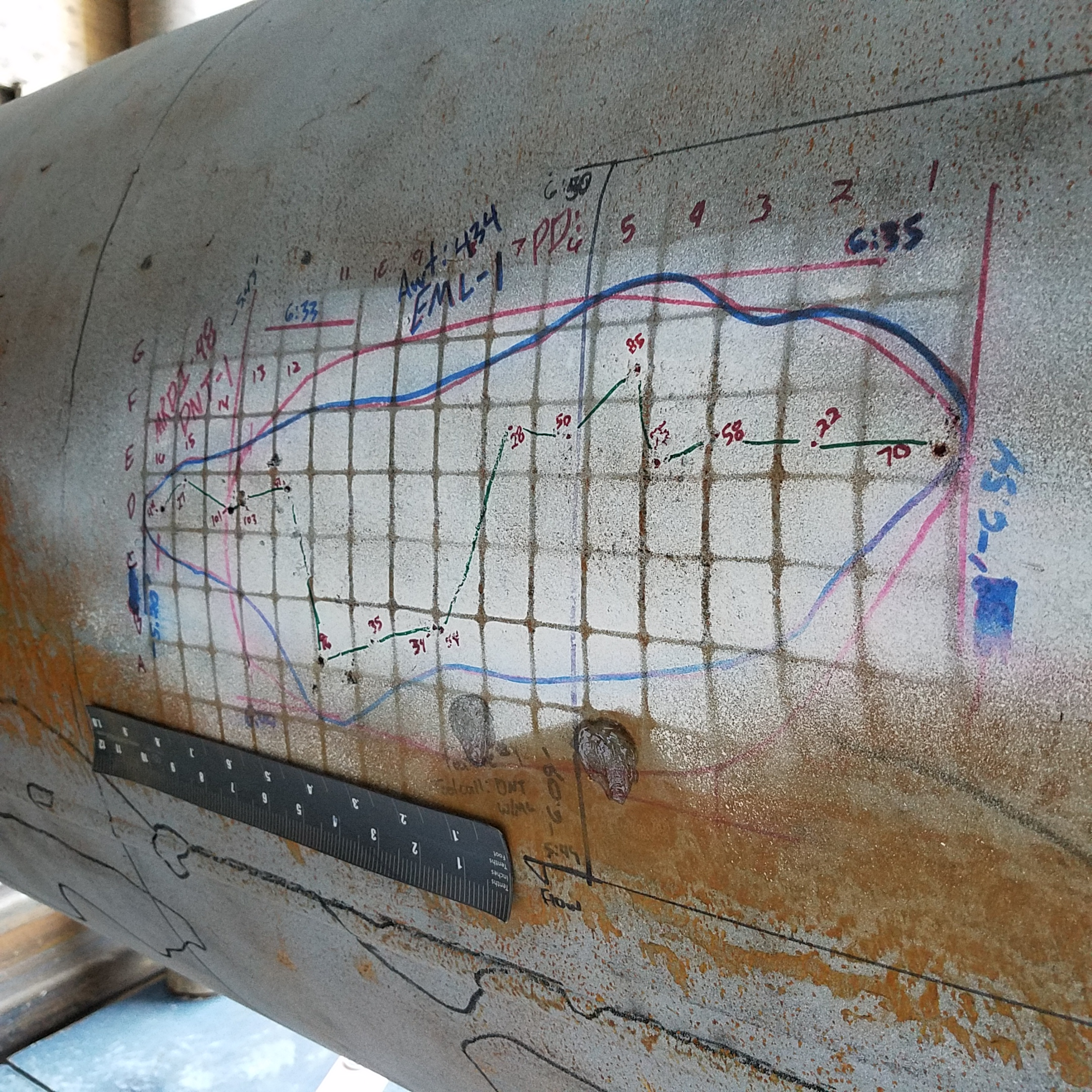
FIMS worked with an NDT crew at selected excavation sites to validate the tool findings and assess the actual pipe condition. We then carried out remaining-strength calculations using engineering assessment software for pipelines.
Why does this matter? Metal-loss depth alone does not tell the whole story. The defect’s length and profile, remaining wall thickness, pipe properties and operating pressure all influence its structural significance. Field verification helps establish a sound basis for those calculations.
The assessment supported targeted intervention at locations that did not meet the applicable acceptance criteria. In this project:
- Internal corrosion locations were repaired using fully welded, full-encirclement steel sleeves.
- External corrosion defects were repaired using composite reinforcement.
These were project-specific repair decisions, supported by assessment of the defects and service conditions. Reinforcement also needs to be considered alongside measures to manage the corrosion mechanism itself.
The operator retained the required operating pressure and flow while avoiding unnecessary extensive pipe replacement. The value came from connecting inspection findings, field evidence and engineering calculations to a focused repair programme.
For pipeline operators, this is a practical question: does your latest ILI report lead to a clear, technically justified repair plan?
FIMS supports field validation, corrosion assessment and remaining-strength evaluation to help operators make those decisions with a stronger engineering basis.
#PipelineIntegrity #CorrosionManagement #AssetIntegrity
Read the original LinkedIn post